
 Turkish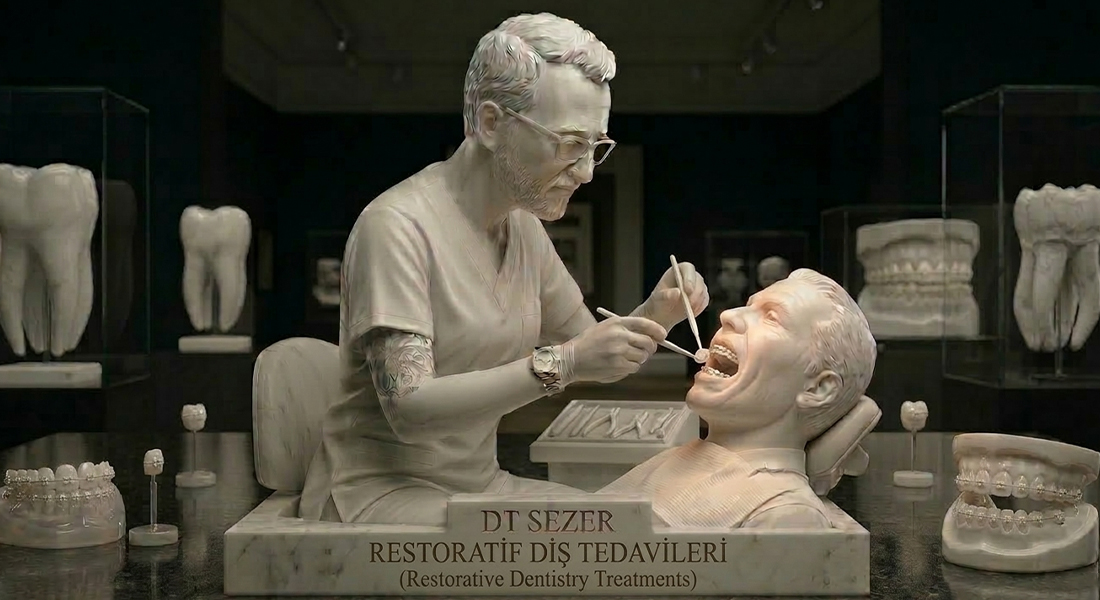
Teeth are among the indispensable elements of daily life in terms of chewing, speech, and aesthetics. However, due to various reasons such as decay, fracture, wear, or trauma, they can gradually lose their structural integrity over time. Restorative dentistry steps in at exactly this point, restoring both the aesthetic appearance and the function of damaged teeth. Dt. Sezer Özdem offers every patient a healthy, strong, and aesthetic oral structure through his extensive clinical experience in restorative dentistry and his modern treatment philosophy.
What Is Restorative Dental Treatment?
Restorative dentistry is the branch of dentistry that aims to restore the natural function, form, and aesthetics of teeth damaged by disease, trauma, wear, or structural deterioration. This discipline, which carries the full meaning of the word “restore,” is based on the principle of preserving as much of the tooth as possible while making it functional again in its most natural form.
Restorative treatment can be evaluated across a wide spectrum — from a simple filling to comprehensive full-mouth rehabilitation. Direct applications can be completed in a single session in a clinical setting, while indirect applications involve procedures that require laboratory support and span multiple appointments.
Dt. Sezer Özdem approaches restorative treatment not merely as a technical repair process, but as a holistic approach that maximizes the patient’s long-term oral health, chewing comfort, and self-confidence. Every restoration plan is created in a personalized manner, with the patient’s age, tooth structure, habits, and aesthetic expectations all evaluated together.
How Is Restorative Dental Treatment Performed?
Restorative dental treatment consists of steps applied following a systematic evaluation and planning process. Dt. Sezer Özdem meticulously follows the protocol below in every case:
Stage 1 – Comprehensive Examination and Diagnosis: The current condition of the teeth is evaluated in detail through intraoral examination, digital radiography, and CBCT imaging when necessary. The depth of decay, the presence of fractures or cracks in the tooth, the condition of existing restorations, and the distribution of occlusal load are determined at this stage.
Stage 2 – Treatment Planning: Based on the diagnostic data, the most appropriate type of restoration is selected for each tooth. The patient is clearly and comprehensibly informed about the planned treatment, the materials to be used, the expected duration, and the final outcome. Aesthetic expectations are also clarified at this stage.
Stage 3 – Tooth Preparation: Under local anesthesia, decayed and damaged tooth tissue is completely removed. Healthy tooth structure is preserved as much as possible; this minimally invasive approach constitutes one of the fundamental principles of modern restorative dentistry. Cavity preparation is brought to a specific shape according to the selected restoration type.
Stage 4 – Restoration Application: In direct restorations (composite filling), the material is applied to the tooth in layers, each layer is polymerized and hardened with a special light device, followed by occlusal adjustment and anatomical contouring. In indirect restorations (inlay, onlay, crown, bridge), an impression is taken in the first session and a temporary restoration is made; the permanent restoration produced in the laboratory from a digital scan or conventional impression model is then fitted at the next session.
Stage 5 – Occlusal Check and Finishing: After the restoration is completed, the patient’s bite and occlusion are carefully checked. Necessary adjustments are made to bring the restoration into full harmony with adjacent and opposing teeth. Surface polishing provides an aesthetic and hygienic final finish.
Stage 6 – Follow-Up Appointment: At the check-up appointments scheduled after restoration, fit, durability, and the relationship with surrounding tissues are evaluated. Dt. Sezer Özdem considers regular follow-up an indispensable step for long-term restoration health.
What Methods Are Used in Restorative Dental Treatment?
Restorative dentistry has a wide range of methods for many different clinical situations. Dt. Sezer Özdem selects the most appropriate method based on the extent of damage, the position of the tooth, and the individual needs of the patient.
1 – Direct Composite Filling
This is the most basic restorative procedure, completed in a single session, in which tooth-colored composite resin material is directly applied to a cavity prepared due to decay or fracture. The composite applied in layers is polymerized and hardened with an LED light device at each layer. Anatomical contouring and surface polishing are then performed to achieve an aesthetic and functional restoration that closely resembles the appearance of a natural tooth. Dt. Sezer Özdem meticulously applies shade selection and layering technique to produce results that are difficult to distinguish from natural teeth.
2 – Inlay and Onlay (Indirect Restoration)
These are laboratory-supported restoration types preferred when damage or decay in the tooth exceeds the limits of a filling, but has not reached a degree that would require a full crown restoration. An inlay describes a restoration that seats within the cavity without touching the cusp areas, while an onlay refers to a more comprehensive restorative solution that also covers one or more cusp areas. Produced from porcelain or zirconia, these restorations offer far superior durability, color stability, and biocompatibility compared to composite fillings.
3 – All-Ceramic and Zirconia Crown
This is a type of restoration that covers all tooth surfaces in cases of severely worn, fractured, heavily filled, or aesthetically unsatisfactory teeth. Since it contains no metal, it causes no metallic discoloration in the gums; all-ceramic and zirconia crowns, which best mimic the natural tooth appearance, are safely used in both anterior and posterior teeth today. In posterior teeth that have undergone root canal treatment, crown application significantly reduces the risk of fracture, preserving the long-term structural integrity of the tooth.
4 – Bridge Prosthesis
This is a traditional restorative method in which one or more missing teeth are completed in a fixed manner by using adjacent teeth as support. A bridge consists of crowns fixed to the abutment teeth on either side and the artificial tooth or teeth (pontic) suspended between them. With the widespread adoption of implant-supported restorations in recent years, the selection of bridge prostheses has become more selective; however, bridges remain important in cases unsuitable for implants, situations requiring a rapid solution, or for economic reasons.
5 – Removable Partial Denture and Full Denture
These are removable prosthetic restorations used in cases where multiple or all teeth have been lost. A partial denture has a structure that is retained by clasps on existing natural teeth, while a full denture is supported entirely by the gum mucosa and bone structure. Thanks to modern prosthetic materials and digital design technologies, today’s removable dentures offer a much lighter, more aesthetic, and more comfortable experience compared to the past.
6 – Laminate Veneer
These are thin porcelain or composite leaves, 0.3 to 0.5 mm thick, bonded only to the front surface of the teeth. Requiring minimal tooth preparation, this method can radically resolve color, shape, and size problems while touching as little tooth structure as possible. At this intersection of restorative and aesthetic approaches, laminates can simultaneously provide solutions to both structural problems such as decay or fracture, and aesthetic concerns such as discoloration or shape irregularities.
7 – Teeth Whitening (Bleaching)
Although technically not a restoration, whitening — which improves tooth color and ensures compatibility with existing restorations — can form an important part of restorative treatment planning. Performing whitening before planning new fillings or crowns allows the restoration shade to be determined according to the correct reference tone.
What Materials Are Used in Restorative Dental Treatment?
The materials used in restorative dentistry are continuously evolving in terms of durability, biocompatibility, aesthetics, and ease of clinical use. Dt. Sezer Özdem prefers the most advanced materials available today in order to provide each patient with the longest-lasting and most natural-looking result.
1 – Composite Resin
This is the most widely used direct restoration material today. Available in a wide color range, this tooth-colored, easily shapeable, and light-cured material produces results virtually indistinguishable from natural teeth. Modern nanofill and nanohybrid composites — with their high durability, smooth surface quality, and color stability — are safely used in both anterior and posterior restorations. Composite, which achieves micro-mechanical adhesion to the tooth via a bonding agent, allows the maximum amount of tooth structure to be preserved.
2 – All-Ceramic (Porcelain)
Porcelain, preferred in restorations requiring high aesthetics, is the material that offers the closest appearance to a natural tooth through its light transmittance and color depth. Feldspathic porcelain and lithium disilicate (e.max) ceramics used in laminate veneers, inlays, onlays, and full crown restorations demonstrate superior aesthetic qualities while possessing a highly biocompatible structure that does not cause allergic reactions. Their fracture resistance produces excellent long-term clinical results when appropriate cases are selected.
3 – Zirconia
Zirconia, which has become one of the most sought-after materials in restorative dentistry in recent years, stands out for its extremely high fracture and wear resistance, metal-free structure, and satisfying aesthetic properties. Monolithic zirconia offers reliable long-term performance — particularly in posterior crowns exposed to intense chewing forces, implant superstructures, and bridge restorations. High-translucency (HT) zirconia ceramics can now also be used in anterior restorations with a level of aesthetic quality approaching that of porcelain.
4 – Glass Ionomer Cement
Distinguished by its ability to form a chemical bond with tooth structure, this material also provides a protective effect against decay through fluoride release. Preferred especially in pediatric patients, root surface caries, and temporary restorations, glass ionomer offers a practical and reliable option in areas where moisture control is difficult and in cases where high aesthetic expectations are not present.
5 – Metal Alloys (Gold, Chromium-Cobalt)
Among traditional restorative materials, metal alloys have been successfully used for years — particularly in posterior inlays and crowns — thanks to their superior durability and long-lasting performance. Gold alloy inlays are restorations that still retain their value for their biocompatibility, their property of not damaging opposing teeth, and their exceptional longevity. However, in today’s practice where aesthetic expectations are paramount, metal restorations are increasingly giving way to ceramic and zirconia alternatives.
6 – CAD/CAM-Fabricated Restoration Materials
Computer-aided design and manufacturing (CAD/CAM) technology makes it possible to process and produce restorative materials with millimetric precision. Sintered zirconia blocks, lithium disilicate discs, and PMMA (acrylic) temporary materials are processed using this method and produced either in the clinical setting or in the laboratory. Impressions taken with digital scanning eliminate the dimensional errors introduced by conventional impression materials, significantly improving the precision and fit quality of restorations.
Who Is Restorative Dental Treatment Suitable For?
Restorative dental treatment is an extremely inclusive treatment discipline that is suitable for different groups depending on the nature and extent of the damage. Dt. Sezer Özdem evaluates each patient’s individual needs and plans the most appropriate restorative approach.
Individuals with Tooth Decay: While a composite filling with minimal cavity preparation is sufficient for early-stage decay, more comprehensive restorations such as inlays, onlays, or crowns may be needed for moderate to advanced decay. The earlier treatment begins, the higher the rate of tooth structure preservation.
Individuals with Fractured or Cracked Teeth: Structural integrity can be restored with bonding or composite restoration for minor fractures, and with an onlay, crown, or laminate veneer for more extensive fractures. Cracks detected in a tooth, if not treated in time, can lay the groundwork for fracture or pulp infection.
Individuals Experiencing Tooth Wear: Significant tooth structure loss can occur due to acid erosion, bruxism (teeth grinding), or abrasive food consumption. In such cases, both aesthetics and function are restored through methods such as direct composite, indirect restoration, or full-mouth rehabilitation.
Those Who Wish to Replace Old or Failed Fillings: Old amalgam or composite fillings that have discolored over the years, started to leak, or have fractured can be renewed with modern and aesthetic materials. Transitioning from amalgam to composite — especially in anterior areas — is a preferred approach both aesthetically and from a health perspective.
Individuals with Missing Teeth: An implant-supported crown or bridge prosthesis allows the missing tooth to be replaced both aesthetically and functionally. If multiple tooth loss or complete edentulism is involved, comprehensive prosthetic rehabilitation is planned.
Individuals with Aesthetic Concerns: Aesthetic concerns such as discoloration, shape irregularities, size differences, or gaps between teeth can be comprehensively resolved through composite bonding, laminate veneers, or digital smile design.
Children and Young People: Decay in primary teeth can be restored with glass ionomer or composite to prevent premature extraction and space loss. In young permanent teeth, protective fissure sealant application is considered a prophylactic intervention that minimizes restorative needs in the future.
Individuals with Systemic Diseases: Diabetes, cancer treatment, or prolonged medication use can trigger tooth decay and dry mouth, increasing restorative needs. Dt. Sezer Özdem conducts treatment planning for patients with systemic conditions in coordination with the relevant physicians.
Frequently Asked Questions
1. What is the difference between a composite filling and an amalgam filling?
Amalgam is a traditional filling material composed of an alloy of mercury, silver, tin, and copper. It was used as the standard option in posterior restorations for many years, standing out for its high durability and affordable cost. However, it carries an aesthetic disadvantage due to its silver-black color, and is increasingly less preferred today due to the mercury compounds it contains. Composite resin, on the other hand, is a modern material that matches the tooth color, does not contain fluoride, and requires minimal cavity preparation. Since it achieves micro-mechanical adhesion to the tooth through an adhesive bonding system, it allows less tooth structure to be removed. Dt. Sezer Özdem prefers composite resin in all suitable cases due to its aesthetic and biocompatibility advantages.
2. Is it normal to experience sensitivity after a filling?
Yes, it is quite normal to experience temporary sensitivity lasting 1 to 3 weeks after the procedure — especially in cases where deep cavities are restored. This sensitivity manifests as a brief sensation in response to hot, cold, or sweet stimuli and resolves on its own over time. If the intensity of sensitivity increases rather than decreasing, if there is pain during chewing, or if it persists beyond a few weeks, a dentist must be contacted. This picture may be a sign that the pulp is beginning to be affected in deep cavities, or that there is a bite discrepancy in the filling. Dt. Sezer Özdem informs all patients in detail about possible findings and monitoring criteria after every filling procedure.
3. How long does restorative dental treatment take?
The duration of treatment varies significantly depending on the method to be applied, the number of teeth to be restored, and the scope of the procedure. A simple composite filling applied to a single tooth can generally be completed in 30 to 60 minutes; indirect restorations such as laboratory-supported inlays, onlays, or crowns require at least two sessions and the total process spans several days. In comprehensive restorative treatments covering multiple teeth, the process may extend to several weeks. Dt. Sezer Özdem can complete the restoration in a single appointment in suitable cases where CAD/CAM digital technology can be used, which provides patients with significant time savings.
4. How should I protect my teeth after restorative treatment?
The most effective way to extend the lifespan of restorative restorations is to maintain daily oral hygiene correctly and consistently. Brushing teeth at least twice a day with a soft-bristled toothbrush, using dental floss every day, and having professional dental cleaning every six months are among the primary priorities. In addition, avoiding biting hard foods such as crusty bread, ice, or hard candy minimizes the risk of fracture for fillings and crowns. If teeth grinding is present, the use of a night guard is mandatory. Dt. Sezer Özdem provides all patients with a personalized care guide, aiming to maximize restoration longevity.
5. Should I replace my old amalgam fillings with composite?
If amalgam fillings are clinically functioning properly and no problems are observed on radiographic evaluation, replacing them solely out of aesthetic concern is not mandatory. However, amalgam fillings that have started to leak, have developed marginal discrepancy, or have decay around them should ideally be renewed with composite or porcelain restorations. Some patients request amalgam replacement purely for aesthetic reasons; when this decision is made consciously with dentist approval and correct planning, it can be implemented without complications. Dt. Sezer Özdem supports the amalgam replacement decision with individual radiographic and clinical evaluation in each case.
Healthy and Strong Teeth
Damaged or worn teeth can be made strong, aesthetic, and long-lasting again with the right restorative approach. With current restoration materials, digital technology, and an individualized treatment philosophy, Dt. Sezer Özdem offers every patient the most appropriate, most lasting, and most natural-looking restorative solution. To learn more about restorative dental treatment or to schedule an examination appointment, you are welcome to contact our clinic.