
 Turkish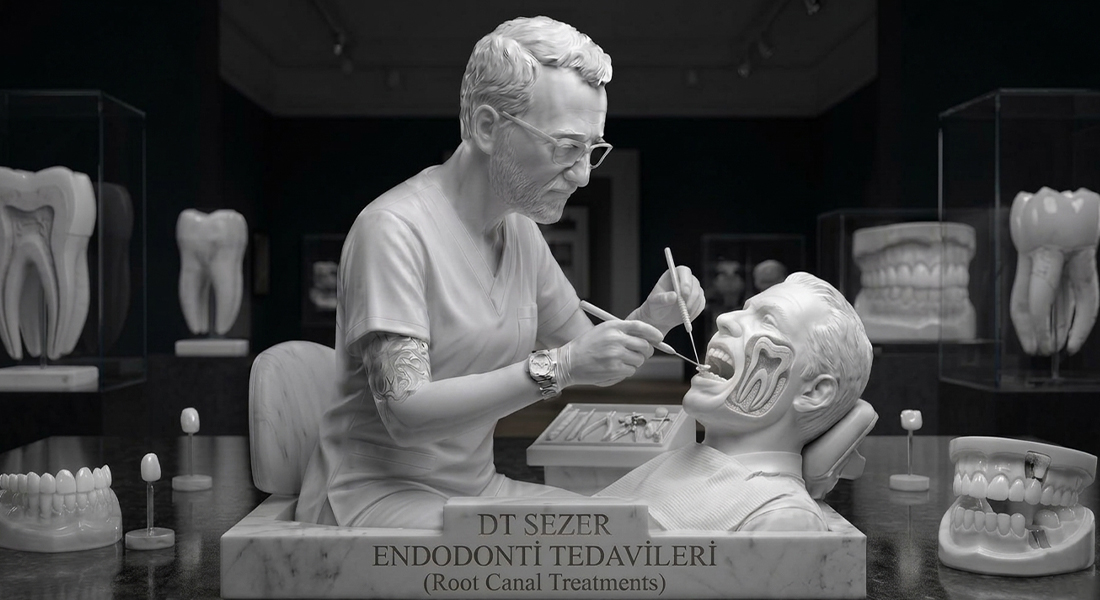
Endodontic Treatments
When the phrase “root canal treatment” is first heard, it is associated with pain and anxiety in many patients. Yet in today’s endodontic practice, root canal treatment has become an extremely comfortable, fast procedure with very high success rates — thanks to modern anesthesia techniques, rotary nickel-titanium file systems, and digital imaging technologies. Dt. Sezer Özdem gives a new lease of life to teeth that are on the verge of being lost, through his deep clinical experience in endodontics and his patient-centered approach.
What Is Endodontics?
Endodontics is a dental specialty derived from the Greek words “endo” (inner) and “odons” (tooth), which studies the health, diseases, and treatments of the pulp (dental pulp) tissue that forms the internal structure of the tooth. The dental pulp is a soft tissue containing nerve fibers, blood vessels, and connective tissue that provides the tooth’s sensitivity and nourishment. This tissue extends within the root canals of the tooth and connects with surrounding tissues through openings at the tips of the roots called the apical foramen.
The primary goal of endodontics is to remove infected or damaged pulp tissue to save the tooth from extraction, prevent infection from spreading to surrounding tissues, and ensure that the tooth remains functional in the mouth over the long term. Dt. Sezer Özdem views endodontic treatment not merely as a technical procedure, but as one of the most valuable steps taken in the interest of preserving the patient’s natural tooth.
Endodontics encompasses not only root canal treatment, but all diagnostic and treatment processes related to the internal structure of the tooth. Identifying the source of pain, testing pulp vitality, treating fractured teeth, and apical surgery also fall under the umbrella of endodontics.
What Is Endodontic Treatment?
Endodontic treatment refers to a series of clinical procedures applied to the pulp chamber and root canals of the tooth, shaped according to the extent of infection or damage. Known among the public as “root canal treatment” or “nerve treatment,” this application constitutes the most frequently encountered and most well-known method in endodontic practice.
The goal of root canal treatment is to completely remove damaged or infected pulp tissue, shape and disinfect the root canals with the help of specialized files, and then completely seal them with a biocompatible filling material (gutta-percha) that prevents bacterial leakage. When all these steps are successfully completed, although the tooth now has a non-vital pulp, it continues to maintain its position in the jawbone and to function in terms of chewing, aesthetics, and continuity.
Dt. Sezer Özdem uses advanced technological tools together in endodontic treatment — including digital radiography, an apex locator (root length measurement device), and rotary file systems — ensuring both the accuracy of treatment and maximum patient comfort.
What Does Endodontic Treatment Do?
The functions and contributions of root canal treatment extend far beyond simply eliminating pain:
Preserves the Natural Tooth: A tooth saved through root canal treatment continues to provide the natural biomechanical sensation and chewing efficiency that no artificial alternative — such as an implant or prosthesis — can fully replicate. As Dt. Sezer Özdem frequently emphasizes, even the best dental implant cannot fully replace a natural tooth.
Prevents the Spread of Infection: If pulp infection is left untreated, bacteria can spread from the root tip to surrounding tissues, the jawbone, and even throughout the body via the bloodstream. Root canal treatment eliminates this infection at its source, preventing serious complications.
Ends the Pain: Severe, throbbing tooth pain caused by pulpitis (inflammation of the dental pulp) is permanently eliminated through root canal treatment. Many patients report being completely free of pain following the procedure.
Preserves the Jawbone: Bone resorption begins over time in the space left by an extracted tooth. Keeping the tooth in place through root canal treatment maintains alveolar bone stimulation and prevents bone loss.
Protects Adjacent Teeth from Drifting and Tipping: An extracted tooth causes adjacent teeth to drift into the space, which creates a foundation for bite irregularities and new dental problems. Preserving the tooth through root canal treatment maintains arch integrity and occlusion.
Ensures Aesthetic Continuity: Especially in anterior teeth, root canal treatment prevents the deterioration of smile aesthetics and allows the natural tooth to remain present without the need for expensive prosthetic alternatives.
What Treatments Does Endodontics Cover?
The field of endodontics encompasses many different clinical procedures beyond root canal treatment. Dt. Sezer Özdem successfully applies the following endodontic treatments in clinical practice:
1 – Root Canal Treatment (Pulpectomy)
This is the fundamental endodontic procedure consisting of the complete removal of infected or irreversibly damaged pulp tissue, shaping and disinfecting the canals, and permanently filling them with gutta-percha. Whether it is a single-rooted anterior tooth or a molar with three or four roots, it is applied with the same meticulousness and systematic approach in every case.
2 – Pulp Capping (Direct and Indirect)
This is a protective procedure applied in situations where the pulp has not yet been fully affected but is under threat. In indirect pulp capping, after the deep decay is cleaned, a biocompatible material (calcium hydroxide or MTA) is placed to protect the pulp and support its self-healing. In direct pulp capping, the same material is applied directly to the pulp surface in cases where small-scale pulp exposure has occurred. Both methods are minimally invasive approaches that should be attempted before root canal treatment.
3 – Pulpotomy
In this procedure — applied especially in primary teeth or young permanent teeth whose root development has not yet been completed — only the pulp tissue in the coronal (crown) portion is removed; the pulp in the root canals is preserved if healthy. This supports the completion of root development. In primary teeth, pulpotomy is also of critical importance for preventing premature tooth loss and maintaining space for permanent teeth.
4 – Root Canal Retreatment (Revision)
In situations such as recurrence of infection in a tooth that has previously undergone root canal treatment, the presence of unfilled canal segments, or a broken instrument within the canal, the existing canal filling is completely removed and treatment is performed again. Canal revision is technically a more challenging procedure compared to the initial application and requires a high level of clinical experience.
5 – Apical Resection (Apicoectomy)
This is a surgical endodontic procedure used in cases where infection at the root tip persists despite root canal treatment or revision. Under local anesthesia, the gum is opened and a few millimeters of the root tip are surgically removed, followed by a special retrograde filling at the root tip. Apicoectomy is applied not as a last resort to save the tooth, but as a specific step in the endodontic treatment protocol.
6 – Intraoral Drainage and Abscess Treatment
When an abscess forms related to a tooth root, a drainage procedure is performed to rapidly relieve swelling and pain. This procedure both quickly improves the patient’s comfort and prepares an appropriate environment for root canal treatment. Supported by antibiotic therapy, this procedure generally constitutes the preliminary step of definitive root canal treatment.
When Is Endodontic (Root Canal) Treatment Necessary?
Whether root canal treatment is needed is determined by interpreting the patient’s symptoms, clinical examination findings, and radiographic evaluation together. It is important to know that Dt. Sezer Özdem evaluates root canal treatment in the following situations:
Irreversible Pulpitis: This is the condition where the pulp has exceeded its capacity for spontaneous healing, accompanied by severe, prolonged, and spontaneous pain. Extreme sensitivity to heat, delayed and prolonged response to cold stimuli, and pain that increases at night are typical signs of this condition.
Necrotic Pulp (Pulp Death): In this condition where the pulp tissue has completely lost its vitality, pain may sometimes not be felt; however, the observation of bone loss at the root tip (periapical lesion) on radiographic examination and the lack of response to vitality testing reveal the indication for root canal treatment.
Periapical Abscess: A bacterial infection focus forming around the root tip may manifest with swelling, pain, and fever. In the case of an acute abscess, drainage is performed first, followed by root canal treatment.
Deep Tooth Decay: In cases of deep decay that has advanced to or is threatening the pulp, root canal treatment becomes unavoidable when pulp exposure is present or when a response cannot be obtained from pulp capping.
Dental Trauma: Fracture, displacement, or luxation of a tooth due to trauma such as a fall, impact, or accident can sever the blood vessels nourishing the pulp. Root canal treatment becomes necessary when the pulp loses its vitality in such cases.
Prosthetic Requirement: In some teeth planned for crown placement due to severe tooth wear or fracture, root canal treatment may be planned prior to prosthetic treatment to ensure the supporting structure of the roots.
Dt. Sezer Özdem never bases the root canal treatment decision on a single finding; he prioritizes reaching the most accurate diagnosis through the holistic interpretation of symptoms, clinical tests, and radiographic evaluation.
How Is Endodontic (Root Canal) Treatment Performed?
Root canal treatment is a multi-step procedure requiring care and precision within a systematic protocol. Dt. Sezer Özdem uses current clinical protocols and advanced technological equipment together in all cases, targeting the best possible outcome at every stage of treatment.
Step 1 – Anesthesia and Isolation: Local anesthesia is applied to completely numb the area. A special latex barrier called a rubber dam is then placed on the tooth to isolate the working area from saliva and bacteria. This isolation both provides a sterile working environment and prevents disinfectant solutions from escaping into the mouth.
Step 2 – Access Opening (Cavity Preparation): An access opening is created using specialized burs through the chewing surface or back surface of the tooth to reach the pulp chamber. At this stage, existing decay and old fillings are cleaned to gain access to the canal orifices.
Step 3 – Locating Canal Orifices and Root Length Measurement: The number and location of canals belonging to the tooth root are determined. The exact length of the canals is established with millimetric precision using an apex locator device and digital radiography. Error in root length measurement is one of the most critical factors that directly affects the success of treatment.
Step 4 – Canal Shaping: Using nickel-titanium rotary files, the canals are enlarged and brought to a tapered and smooth shape — working from the apex toward the crown or using hybrid techniques. Throughout this stage, the canals are continuously subjected to irrigation (washing) with 2.5–5.25% sodium hypochlorite solution and EDTA. Irrigation reduces bacterial load, dissolves organic debris, and removes the smear layer.
Step 5 – Disinfection and Medication: After shaping and irrigation are complete, an antimicrobial agent such as calcium hydroxide is placed within the canal and a temporary closure is made. This stage is particularly important in situations where treatment cannot be completed in a single session, where infection is heavy, or where an abscess is present.
Step 6 – Canal Filling (Obturation): Once the canals are fully disinfected, they are filled three-dimensionally with gutta-percha cones — a biocompatible rubber-based material — and canal sealer. This filling prevents bacteria from multiplying again in the canal and re-infecting the surrounding tissues. Lateral condensation, thermoplasticized gutta-percha, and single cone techniques are among the most widely used obturation methods.
Step 7 – Coronal Restoration: After root canal treatment is complete, the coronal portion of the tooth must be closed with an appropriate restoration. Since teeth that have undergone root canal treatment become more susceptible to fracture due to loss of pulp, crown restoration is of great importance — especially in posterior teeth. Dt. Sezer Özdem evaluates root canal treatment simultaneously with prosthetic restoration planning to ensure long-term dental health.
How Long Does Endodontic (Root Canal) Treatment Take?
The duration of root canal treatment shows significant variation depending on the tooth’s anatomical structure, the number and complexity of root canals, the intensity of the infection, and the selected treatment protocol.
In Terms of Number of Sessions
Root canal treatment can be completed in a single session or across multiple sessions. Which protocol will be applied is determined based on the tooth’s clinical condition, whether the bacterial load has been completely cleared from the canal orifice area, and the patient’s general health status.
Single-Session Root Canal Treatment: If there is no acute abscess, severe systemic symptoms, or retreatment involved, many root canal treatments can be successfully completed in a single appointment. This approach reduces the patient’s appointment burden and eliminates risks such as local anesthesia failure or temporary filling leakage.
Multi-Session Root Canal Treatment: In the presence of heavy infection, chronic abscess, extensive periapical lesion, or anatomically complex canals, treatment may be spread over multiple appointments. Calcium hydroxide placed in the canal between sessions significantly reduces bacterial load, improving the success of the filling at the second session.
In Terms of Duration Per Session
- Single-rooted anterior teeth (incisors, canines): Generally 45 to 60 minutes
- Double-rooted premolar teeth: Generally 60 to 75 minutes
- Three- or four-rooted molar teeth: Generally 75 to 120 minutes
- Canal revision (retreatment) cases: Duration may be extended due to removal of existing filling material
Thanks to modern equipment such as rotary file systems and apex locators, Dt. Sezer Özdem significantly shortens treatment durations while never compromising on quality or accuracy of treatment. The session plan for each case is clearly shared with the patient before treatment begins.
Frequently Asked Questions
1. Is root canal treatment really very painful?
This is one of the most common and deeply rooted misconceptions about root canal treatment. Since root canal treatment is performed under local anesthesia, no pain is felt during the procedure. The actual pain in question occurs not during the root canal treatment itself, but during the pulpitis or abscess process that leads to it. With modern anesthesia techniques and calibrated needle systems, even the injection has become almost imperceptible today. Mild sensitivity lasting a few days following the procedure is an expected and normal healing finding that can be easily managed with prescribed pain relievers. One of the most frequent pieces of feedback Dt. Sezer Özdem receives from patients is: “It was much easier than I expected.”
2. How long does a root canal-treated tooth last?
A tooth that has undergone root canal treatment can remain in the mouth for decades — or even a lifetime — when the treatment is correctly performed and an appropriate restoration is placed on top. The most critical factors determining long-term success are complete filling of the canals, ensuring good coronal seal, and crown restoration — particularly in posterior teeth. In addition, good oral hygiene, regular dental check-ups, and the use of a night guard if bruxism is present directly affect the tooth’s lifespan.
3. Is it mandatory to have a crown after root canal treatment?
Crown placement after root canal treatment is strongly recommended for posterior teeth (premolars and molars). The primary reason for this is that teeth without a pulp are far more susceptible to fracture, and a crown protects the tooth against chewing forces, ensuring long-term structural integrity. For anterior teeth, composite restoration or laminate veneer may provide sufficient results depending on the fracture risk and aesthetic condition of the tooth. Dt. Sezer Özdem individually evaluates the need for coronal restoration in each case.
4. What should be done if the tooth starts to darken after root canal treatment?
Color darkening in the tooth may be observed following root canal treatment; this is explained by the removal of pulp tissue and the seeping of blood pigments into the dentinal tubules. For those who notice that a treated tooth has darkened, internal whitening (walking bleach) or external in-office whitening applications offer highly effective solutions. In teeth where discoloration cannot be resolved, laminate veneers or zirconia crowns may be preferred. Dt. Sezer Özdem individually plans the most appropriate aesthetic solution for each case.
5. What is done if root canal treatment fails?
Although root canal treatment generally has a high success rate, in some cases the periapical infection may persist or recur. The main options that can be pursued in this situation are: repeating the root canal treatment (retreatment), apicoectomy (surgery), or as a last resort, tooth extraction. Dt. Sezer Özdem addresses treatment failure cases with a comprehensive re-evaluation to determine the most appropriate protocol for the patient’s current condition. Extraction is not resorted to until every endodontic option to save the tooth has been exhausted.
Root canal treatment — when applied in a timely manner and in the right hands — marks the end of pain, the saving of the tooth, and the beginning of many years of function. Dt. Sezer Özdem targets the best outcome in every case with advanced technological equipment, current endodontic protocols, and a patient-centered approach. To learn more about root canal treatment or to schedule an appointment, you are welcome to contact our clinic.